
Empatheum®
Empatheum is a system for embedding reflective practice, restorative supervision and compassionate leadership in health and care.
Designed for Professional Advocates, clinical supervisors, nurse and midwife leaders, educators, and others working in emotionally demanding roles, Empatheum combines live reflective spaces, practical skills development, and ongoing leadership support to help reflective and restorative approaches become embedded over time.
Do any of these problems sound familiar?
- – Staff attend supervision training but struggle to apply it in practice
- – Professional Advocates lack confidence facilitating reflective conversations
- – Clinical supervision is inconsistent across teams
- – Leaders carry emotional responsibility with little support themselves
- – Reflective practice feels difficult to sustain
- – Senior leaders, including Lead PNA/PMA and PAs feel professionally isolated
- – Teams struggle to create psychologically safe spaces for reflection
Empatheum helps with these common challenges.
Training told them what to do. Empatheum showed them how.
Three participants, from staff nurse to education lead, on what they now do differently at work.
When reflective groups turn into moaning sessions
“We get all the theory… but you don’t actually get shown how to do it.”
Practice Development and Education Lead, NHS Trust
Her preceptor forums tended to descend into negativity, and she dreaded them. Using the skills from Empatheum, she set a theme, contained the difficult voices, and turned the forum into something genuinely useful.
For your organisation: supervisors who can hold a group, so staff leave feeling better rather than worse.
“We don’t have time for this on a full unit”
“The unit was full… but it was worth just taking that five minutes aside.”
Senior Sister, NHS Trust
A distressed colleague was acknowledged and held without rushing to fix things, and a proper follow-up was booked, all inside a busy shift.
For your organisation: compassionate leadership that happens on the ward, not just in the training room.
PNAs get trained, then the role goes quiet
“It made me put my PNA thinking cap on. It made me more active, made me talk about the role more.”
Staff Nurse, NHS Trust
Weekly sessions kept the role live. Colleagues now come to her, and she feeds learning back to her manager.
For your organisation: a return on your PNA investment, with advocates using the role more consistently.
What is Empatheum?
Empatheum is a structured, ongoing reflective leadership and supervision experience designed for nurses, midwives, and healthcare leaders who support others in emotionally demanding roles.
Many organisations invest in restorative supervision, reflective practice, and compassionate leadership training, yet staff are often left trying to apply these approaches in highly pressured environments without ongoing support, modelling, or psychologically safe spaces to reflect themselves.
Empatheum exists to bridge that gap.
Through a combination of live reflective practice groups, practical skills development, on-demand learning, and cross-organisational peer support, Empatheum helps staff move from uncertainty to confidence, from isolation to connection, and from theoretical understanding to real-world reflective leadership practice.
The experience is designed for Professional Nurse and Midwife Advocates (PNAs/PMAs), clinical supervisors, nurse and midwife leaders, educators, and others who are responsible for supporting staff wellbeing, reflection, and compassionate leadership within health and care settings.
Why is Empatheum needed?
Reflective practice, restorative clinical supervision, and compassionate leadership are widely recognised as essential within health and care organisations. However, a consistent challenge remains: training alone does not reliably translate into sustained, everyday practice.
Staff may leave training with a clear understanding of what psychologically safe supervision and compassionate leadership look like, yet return to highly pressured environments without the ongoing support, reflective space, confidence, or leadership reinforcement needed to apply these approaches consistently in real-world situations.
Over time, reflective conversations can become less frequent, emotionally difficult discussions may be avoided, and leaders often revert to problem-solving and firefighting under pressure. At the same time, many of the people responsible for supporting others, such as PNAs, clinical supervisors, ward managers, and nurse leaders, may themselves feel isolated, emotionally overloaded, or unsupported in the role.
As a result, organisations can find that reflective practice is introduced but not fully embedded, supervision is trained but not consistently sustained, and compassionate leadership becomes difficult to maintain amidst the realities of modern healthcare work.
Empatheum was designed to bridge this gap by providing the ongoing reflective infrastructure, psychologically safe spaces, leadership support, and practical development needed to help reflective and restorative approaches become part of everyday organisational culture over time.
The Development of Empatheum
“Empatheum was designed to bridge the gap between supervision training and real-world practice.”
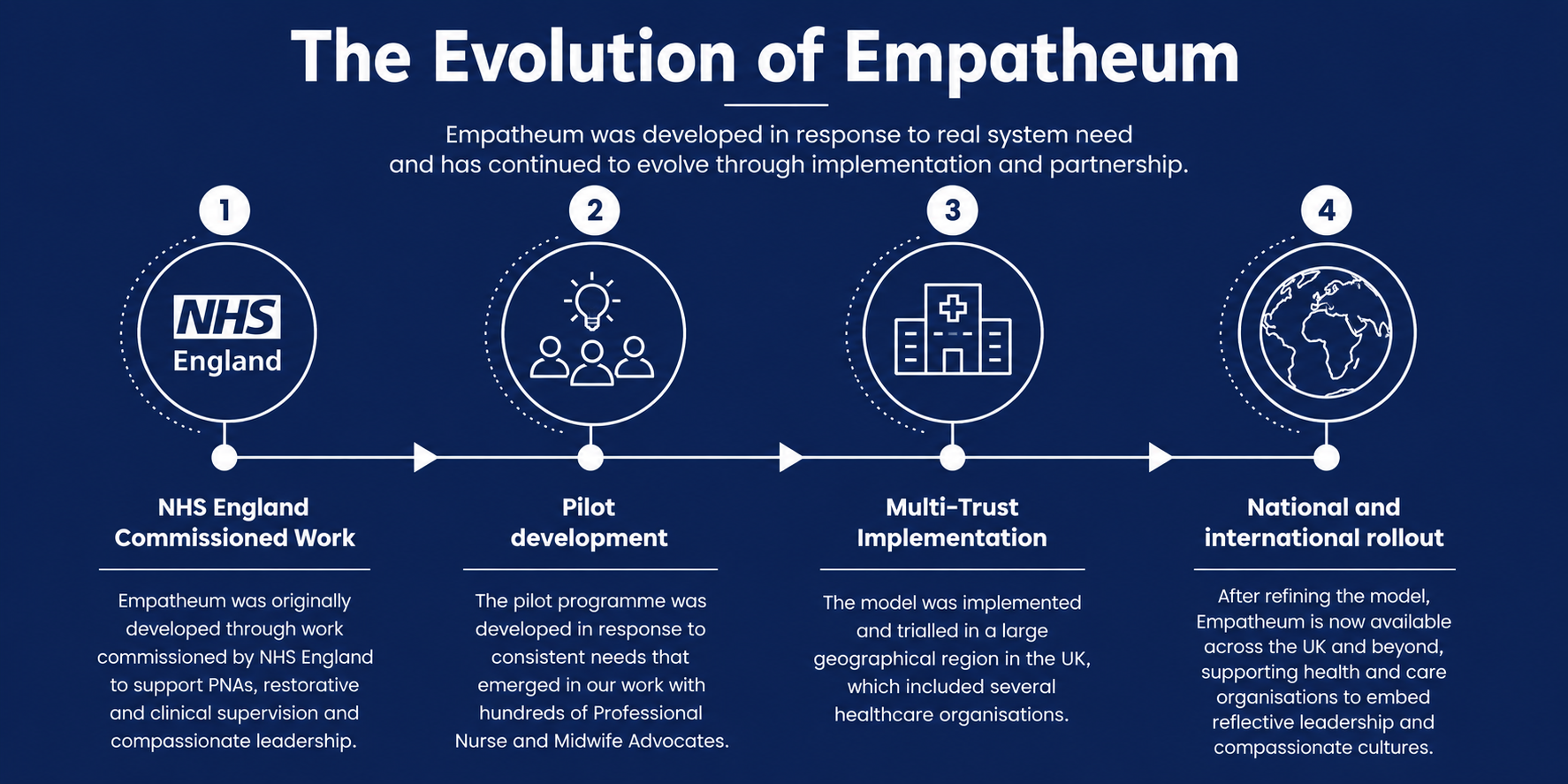
Empatheum was originally developed through work commissioned by NHS England to support Professional Nurse Advocates (PNAs), restorative clinical supervision, and compassionate leadership across multiple organisations in the North West of England.
Through this work, a consistent pattern emerged.
Whilst many staff valued restorative and reflective approaches, organisations often struggled to sustain these practices consistently over time once initial training had ended.
Many staff felt unconfident in providing reflective and restorative supervision due to having limited opportunity to witness, experience and practice this in their initial training.
Leaders, supervisors, and advocates frequently described feeling isolated in the role, lacking psychologically safe spaces to reflect themselves, and finding it difficult to maintain reflective approaches amidst the pressures of day-to-day healthcare work.
Empatheum was developed in response to these realities.
The model has continued to evolve through ongoing implementation, reflective practice groups, leadership support work, and collaboration with nurses, midwives, and healthcare leaders across NHS organisations.
Today, Empatheum provides organisations with an ongoing reflective leadership and supervision infrastructure designed to help compassionate leadership and reflective practice become embedded more sustainably within everyday work.
How Empatheum Works
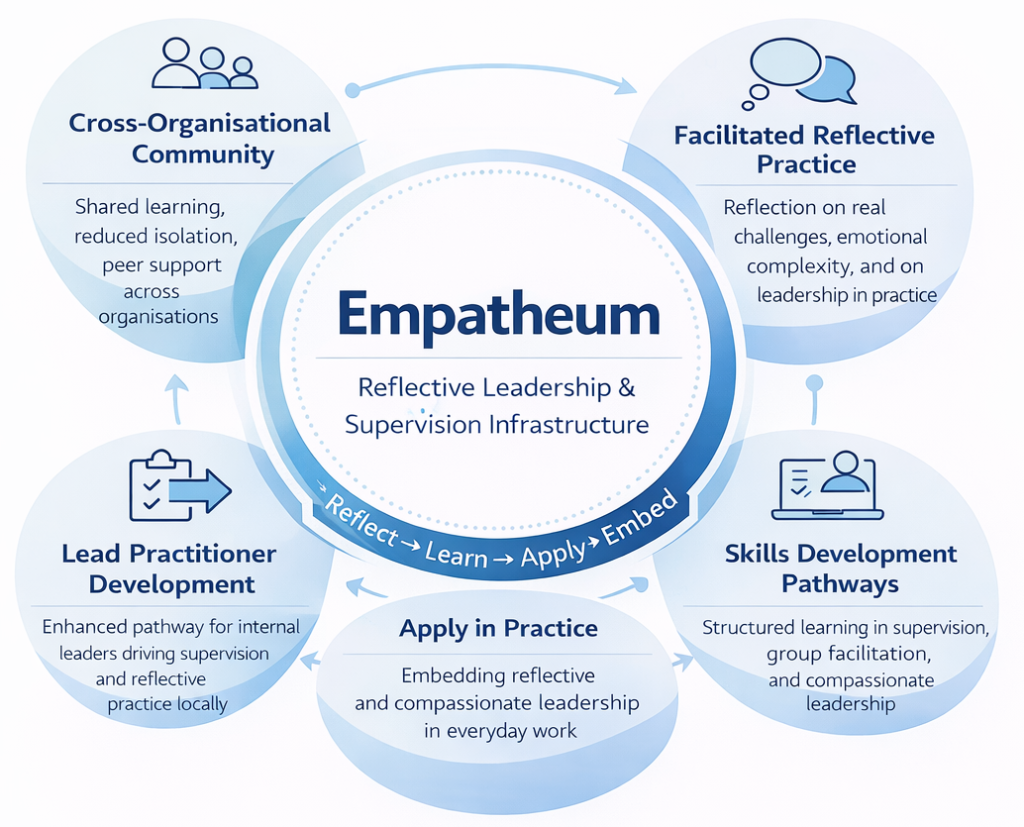
Empatheum is delivered as a 12-month organisational experience designed to help reflective practice, compassionate leadership, and psychologically safe supervision become embedded over time rather than remaining isolated training events.
The model combines ongoing reflective and restorative spaces, practical skills development, cross-organisational learning, and structured support for a designated internal Lead Practitioner who helps sustain engagement locally within your organisation.
Together, these elements create an ongoing reflective infrastructure that supports staff not only to learn reflective and restorative approaches, but to continue applying, strengthening, and sustaining them within the realities of everyday healthcare work.
The Empatheum Ecosystem of Support
To support this process, Empatheum combines:
> Live facilitated reflective practice and restorative support
> Practical skills development through live training and masterclasses
> On-demand learning and real supervision demonstrations
> Cross-organisational peer connection and shared learning
> Dedicated support for internal Lead Practitioners
> Ongoing opportunities to reflect, learn, apply, and embed practice over time
The Lead Practitioner: Tying the partnership together
Each organisation identifies a designated Lead Practitioner who acts as the bridge between Empatheum and their internal cohort of staff.
This role is central to helping reflective practice and compassionate leadership become embedded and sustained over time within the realities of everyday organisational life.
In many organisations, reflective initiatives can struggle to maintain momentum once initial training has ended, particularly when staff are under pressure and engagement relies solely on individual motivation. The Lead Practitioner helps strengthen local engagement, encourages staff to access the opportunities available within Empatheum, and supports reflective and restorative approaches becoming more visible within day-to-day practice.
Lead Practitioners are not expected to coordinate or manage the programme operationally. Instead, they are supported by Empatheum through their own dedicated reflective leadership spaces, strategy discussions, and cross-organisational peer support with Leads from other organisations.
This creates a supported partnership approach that helps organisations move beyond one-off training towards more sustainable reflective leadership and supervision cultures over time.
Reflective practice is more likely to sustain when organisations actively support it internally.
Cross-organisational community
Empatheum brings together cohorts of nurses, midwives, supervisors, and healthcare leaders from different organisations into shared reflective and learning spaces.
For many people working in emotionally demanding leadership and support roles, there can be a sense of isolation in carrying responsibility for others whilst having limited opportunities to reflect openly themselves. Bringing together staff from different organisations helps create psychologically safe spaces where experiences, challenges, uncertainty, and ideas can be explored honestly with others who understand the realities of the work.
This cross-organisational model also broadens perspective. Participants are exposed to different ways of thinking, facilitating, and supporting staff across a range of clinical and organisational contexts, helping reflective practice become richer, more adaptable, and less dependent on isolated local cultures.
Over time, these shared spaces help create a sense of connection, normalisation, mutual support, and ongoing reflective learning across organisational boundaries.
Facilitated Reflective Practice
Many healthcare leaders, supervisors, and advocates spend significant time supporting others whilst having little protected space to pause, reflect, and process the emotional complexity of their own role.
Over time, emotionally demanding work can lead people to operate in constant problem-solving and firefighting modes, making it harder to remain reflective, emotionally attuned, and psychologically present in conversations with colleagues and teams.
Empatheum provides ongoing facilitated reflective practice and restorative support spaces where participants can slow down, think together, explore emotionally difficult situations, and reconnect with the relational aspects of compassionate leadership and supervision.
These psychologically safe group spaces are carefully facilitated to support reflection, emotional processing, perspective-taking, and shared learning rather than blame, performance management, or uncontained “offloading”.
Over time, this ongoing reflective process helps staff strengthen emotional awareness, reflective capacity, confidence in difficult conversations, and their ability to support others with greater steadiness and compassion within the realities of healthcare work.
Skills development pathway: On-demand learning
Empatheum’s on-demand learning pathways are designed to help staff move beyond theoretical understanding towards greater confidence and skill in real-world reflective leadership, supervision, and emotionally supportive conversations.
Rather than relying solely on traditional teaching approaches, the platform includes practical video demonstrations, reflective supervision examples, and psychologically informed facilitation in action, allowing participants to observe how reflective and compassionate conversations can be held within complex real-life situations.
This modelling process helps make reflective practice and supervision feel more accessible, understandable, and psychologically safe, particularly for staff who may feel uncertain or anxious about facilitating emotionally open conversations themselves.
All learning is accessed through the Empatheum platform, providing staff with flexible, ongoing opportunities to revisit ideas, strengthen confidence, and continue developing reflective leadership capability over time.
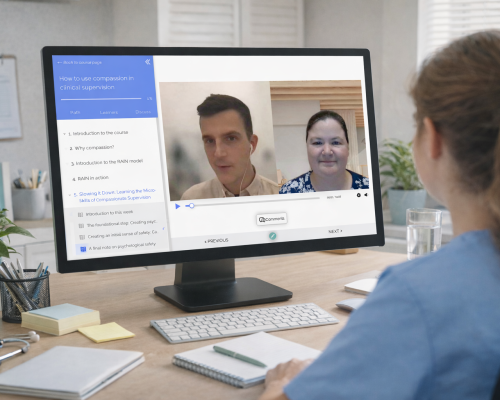
“Seeing reflective supervision modelled in real situations helps staff move from uncertainty towards confidence.”
Skills Development Pathway: Live Training and Masterclasses
Alongside ongoing reflective practice spaces, Empatheum provides live training and masterclasses designed to strengthen the practical relational and leadership skills required to support staff effectively within emotionally demanding healthcare environments.
These sessions move beyond theoretical leadership teaching and focus on the real-world conversations and situations that leaders, supervisors, and advocates encounter in practice, particularly where emotion, uncertainty, conflict, distress, or vulnerability may be present.

Training Topics Include:
> Psychologically safe, trauma-informed supervision and reflective practice
> Compassionate leadership in action
> How to deal with emotive conversations (e.g. burnout, grief, conflict)
> How to navigate group and team dynamics
> How to start listening, coaching and empowering avoid advice-giving and firefighting
> How to use a values-led approach and feel prepared for any kind of supervision situation
Sessions are practical, experiential, and reflective in style, helping participants not only understand these approaches conceptually, but experience, practise, and apply them within psychologically safe learning environments.
Over time, this ongoing development process helps staff build greater confidence, reflective capacity, relational awareness, and effectiveness in supporting colleagues and teams within the realities of healthcare work.
How organizations can use Empatheum
Organisations are increasingly recognising that reflective practice, restorative supervision, and compassionate leadership require more than one-off training in order to sustain over time.
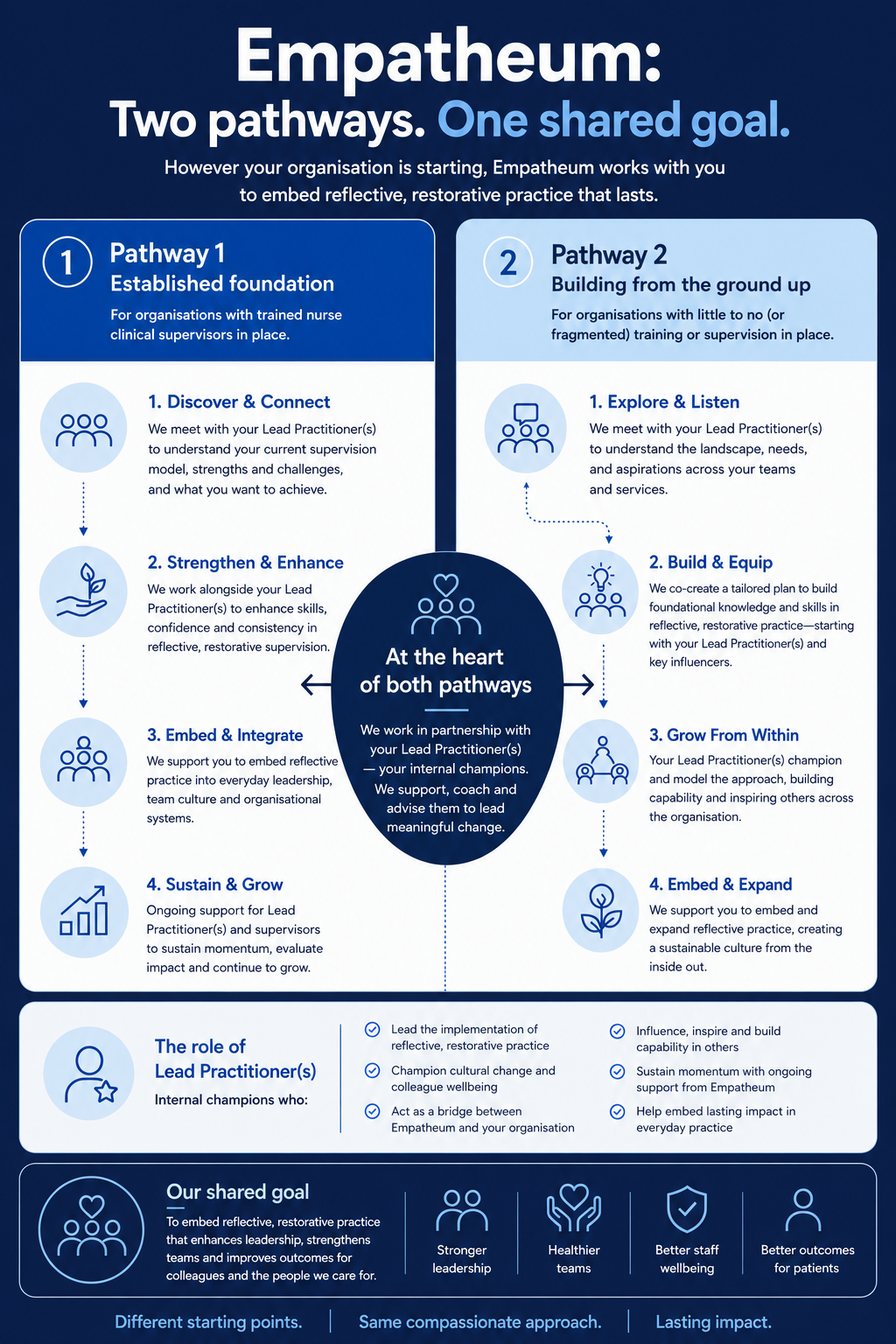
There tend to be two broad classes of organisations which we support:
1) Clinical supervision and reflective practice training for nurses and midwives are either highly fragmented, or lacking entirely in the organisation.
In this case, there is a need for initial training as well as the ongoing support to help embed and implement the work.
2) Clinical supervision and reflective practice may have already been invested in (e.g. through the PNA programme, or other clinical supervision training) but there is a need for continued professional development and support to scale and embed things.
Empatheum supports organisations in both of these situations. The image below outlines this.
Organisations are using Empatheum to help:
> Strengthen psychologically safe supervision and reflective conversations
> Reduce isolation amongst PNAs, supervisors, and healthcare leaders
> Support emotionally demanding leadership roles more sustainably
> Increase confidence facilitating reflective and restorative spaces
> Create ongoing reflective support for leaders and supervisors
> Move reflective practice from isolated initiatives into everyday organisational culture
> Provide flexible, scalable reflective leadership development across teams and organisations
Rather than replacing existing supervision or leadership initiatives, Empatheum is designed to strengthen and sustain them over time through ongoing reflective support, leadership development, and practical implementation.
In summary, organisations are using Empatheum to help:
> Strengthen or implement psychologically safe supervision and reflective conversations
> Reduce isolation amongst PNAs, supervisors, and healthcare leaders
> Support emotionally demanding leadership roles more sustainably
> Increase confidence facilitating reflective and restorative spaces
> Create ongoing reflective support for leaders and supervisors
> Move reflective practice from isolated initiatives into everyday organisational culture
> Provide flexible, scalable reflective leadership development across teams and organisations
Rather than replacing existing supervision or leadership initiatives, Empatheum is designed to strengthen and sustain them over time through ongoing reflective support, leadership development, and practical implementation.
Empatheum Group Reflective Practice Facilitation Pathway
One of the most effective ways to embed reflective practice and restorative supervision within healthcare organisations is through high-quality internally facilitated group reflective practice.
However, organisations often discover that attending introductory supervision or reflective practice training is not enough, on its own, to create confident and sustainable facilitators.
Many staff complete training with a good theoretical understanding of reflective practice, but understandably still do not feel confident leading groups in real-world health and care environments.
At the same time, organisations sometimes unintentionally nominate staff into facilitation roles who may not yet have the organisational influence or protected time required to successfully embed reflective practice internally.
For this reason, the Empatheum Enhanced Facilitation Pathway is intentionally designed as a more selective and supported development pathway.
Rather than training large numbers of staff indiscriminately, the pathway is designed for carefully identified individuals who:
- > Already demonstrate strong interpersonal and reflective capacity
- > Are genuinely motivated to support colleagues
- > Have some level of organisational backing
- > Are in a position to realistically begin implementing reflective practice locally
This creates a far stronger foundation for sustainable implementation.
You have now read a general overview of what Empatheum is, who it is for, and how it works for different organisations.
If you are a commissioner or exploring this for your organisation, as a next step we recommend downloading our full Info Pack below.
Once you have taken a look over this, we welcome any questions and invite you to book a call with us to discuss things further.
Please note there is also a list of FAQs at the bottom of this page.
Get Everything You Need to Know About Empatheum
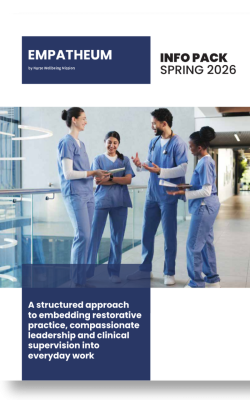
Download our free info pack for a full overview -or chat with our AI Assistant if you have a specific question.
Prefer to talk to a person? Reach us at empatheum@nursewellbeingmission.com to book a call.
Frequently asked Questions
Below you’ll find answers to some of the most common questions we receive from Healthcare Organizations, Leaders, Professional Nurse Advocates (PNAs), Professional Midwife Advocates (PMAs) and Clinical Supervisors.
Understanding Empatheum
What is Empatheum?
Empatheum is a reflective leadership and supervision platform for healthcare professionals who support, lead, supervise or care for others.
It combines facilitated reflective practice groups, live development sessions, peer connection, self-compassion spaces and on-demand learning into one ongoing programme of support.
Unlike one-off training events, Empatheum provides a structured environment where people can continue developing their confidence, skills and reflective capacity over time.
Who is Empatheum designed for?
Empatheum is designed for healthcare professionals who support others in emotionally demanding environments, including:
- • Professional Nurse Advocates (PNAs)
• Professional Midwife Advocates (PMAs)
Professional Advocates (PAs)
- • Clinical supervisors
• Nurse and midwife leaders
• Practice educators
• Professional leads
• Managers and senior leaders
• Staff wellbeing and workforce teams
Many organisations initially use Empatheum to support PNAs and PMAs, but it can also support a much broader range of healthcare leaders and supervisors.
Is Empatheum only for nurses and midwives?
No, Empatheum can support other groups of health and care professionals.
We are happy to discuss whether Empatheum would be suitable for your organisation or workforce.
What outcomes is Empatheum designed to support?
Empatheum is designed to support outcomes such as:
- • Increased confidence in restorative clinical supervision and leadership
• Greater reflective capacity and self-awareness
• Reduced professional isolation
• Improved confidence in supporting others
• Stronger peer connection and community
• Greater use of reflective practice skills in day-to-day work
• More sustainable and compassionate leadership
The specific outcomes experienced will vary depending on each individual’s role, context and level of engagement.
Reflective Practice & Supervision
What is restorative clinical supervision?
Restorative clinical supervision is a structured reflective conversation that helps healthcare professionals process the emotional demands of their work.
Rather than focusing solely on performance or problem-solving, restorative supervision creates space for reflection, emotional processing, learning and professional growth.
The aim is to support staff wellbeing while also enhancing effectiveness, resilience and compassionate practice.
Why doesn't supervision or leadership training alone create lasting change?
Training is important, but attending a course does not automatically lead to confidence or sustained behaviour change.
Many healthcare professionals leave training understanding the theory but still feel unsure about applying it in practice.
Common barriers include:
- • Lack of confidence
• Limited opportunities to practise
• Competing workplace pressures
• Professional isolation
• Lack of ongoing support and feedback
Empatheum was designed to bridge the gap between learning and implementation by providing ongoing opportunities for reflection, practice and support.
How does Empatheum support Professional Nurse Advocates (PNAs) and Professional Midwife Advocates (PMAs) and Professional Advocates (PAs)?
Many professional advocates leave training feeling enthusiastic but uncertain about how to apply their learning in practice.
Empatheum supports PNAs, PMAs and PAs by providing:
- • Ongoing reflective spaces
• Opportunities to observe supervision in action
• Practical skills development
• Peer support and networking
• Access to experienced facilitators
• Support with confidence and implementation challenges
This helps participants move from understanding the theory to applying it in real-world settings.
How does Empatheum support healthcare leaders?
Healthcare leaders are often expected to support others while having limited opportunities to reflect themselves.
Empatheum provides psychologically safe spaces where leaders can:
- • Reflect on complex situations
• Explore challenges and uncertainty
• Develop compassionate leadership and restorative clinical supervision skills
• Reduce professional isolation
• Strengthen their confidence and resilience
The aim is to help leaders sustain themselves while continuing to support others effectively.
Can Empatheum help organisations build a more reflective culture?
Yes.
While individual development is important, sustainable change often requires more than training individual staff members.
Empatheum helps organisations strengthen reflective practice by providing ongoing structures that encourage reflection, learning, peer support and compassionate leadership over time.
This can help reflective practice become part of everyday culture rather than a one-off initiative.
Comparing Approaches
How is Empatheum different from traditional training?
Traditional training is often delivered as a one-off event.
While participants may leave feeling inspired, it can be difficult to maintain momentum once they return to busy clinical environments.
Empatheum provides ongoing support through:
- • Regular facilitated reflective spaces
• Live leadership and supervision development sessions
• Peer learning and connection
• Self-compassion and wellbeing support
• On-demand learning resources
This helps participants continue developing their skills and confidence long after formal training has finished.
How is Empatheum different from Schwartz Rounds?
Schwartz Rounds provide valuable opportunities for staff to reflect on the emotional impact of healthcare work through large-group storytelling and discussion.
Empatheum serves a different purpose.
While reflection is central to both approaches, Empatheum places greater emphasis on helping participants develop the skills, confidence and support needed to embed reflective practice, restorative supervision and compassionate leadership in their day-to-day work.
Participants within Empatheum have the opportunity to learn the Empatheum Model of Group Reflective Practice — a structured approach that draws on systemic thinking and is distinct from the Schwartz Rounds model.
Alongside learning the model, participants are supported to:
- Facilitate reflective conversations
- Develop supervision skills
- Build confidence holding groups
- Support colleagues more effectively
- Implement reflective practice within their own teams and organisations
Many organisations may find that Schwartz Rounds and Empatheum are complementary rather than competing approaches, with each offering different benefits for staff and organisations.
How is Empatheum different from other clinical supervision training?
Many clinical supervision and reflective practice programmes provide valuable training in the principles, frameworks and skills needed to facilitate supervision and reflective conversations.
Empatheum serves a different purpose.
While traditional training is often delivered as a one-off course or workshop, Empatheum provides an ongoing environment where participants can continue developing their confidence, skills and practice over time.
Participants don’t simply learn about what reflective practice is, they learn the “how to” and actively participate in it.
Through live reflective spaces, supervision-focused development sessions, peer learning, observation and on-demand resources, participants have ongoing opportunities to deepen their understanding, learn from others and apply their learning in real-world settings.
For organisations seeking to embed reflective practice and supervision into everyday culture, ongoing support and implementation are often just as important as the initial training itself.
Many organisations choose to use Empatheum alongside existing supervision training, while others use Empatheum as their primary approach to developing reflective practice, supervision and compassionate leadership capability.
Access & Licensing
Can organisations licence Empatheum for groups of staff?
Yes.
Empatheum is primarily offered through organisational licences, allowing groups of staff to access the platform and participate together over a defined period.
This creates opportunities for shared learning, peer support and culture development while reducing the burden on organisations to create and facilitate reflective spaces themselves.
We currently offer two licence pathways:
- Organisations with existing clinical supervision training in place
For organisations that already have trained clinical supervisors (such as PNAs, PMAs or other supervisors) and are looking to further develop confidence, strengthen skills, and support the ongoing implementation of reflective practice and restorative clinical supervision. - Organisations looking to build supervision capability from the ground up
For organisations with little or no existing clinical supervision infrastructure that are looking to train staff and provide ongoing support to embed reflective practice, restorative clinical supervision and compassionate leadership over time.
To learn more, we recommend downloading our Information Pack, exploring questions with our AI Assistant, or booking a discovery call so we can discuss your organisation’s needs and goals.
How long does access last?
Empatheum is typically licensed on an annual basis.
Can larger organisations stagger access across different cohorts?
Yes.
For larger licences, organisations can often phase access across multiple cohorts. This can help spread participation across different teams, support protected learning time, and make implementation more manageable.
We are happy to discuss the most suitable approach for your organisation.